

Every founder who has built something real knows the feeling of being pulled in two directions by the same decision. Grow faster, or build sturdier. Ship today, or ship something that lasts. Chase the big idea, or finish the small task in front of you.
Nobody warns you about this part. The tension does not go away once the business works. It usually gets louder, right around the point where other people start depending on your answer.
Growth vs strength
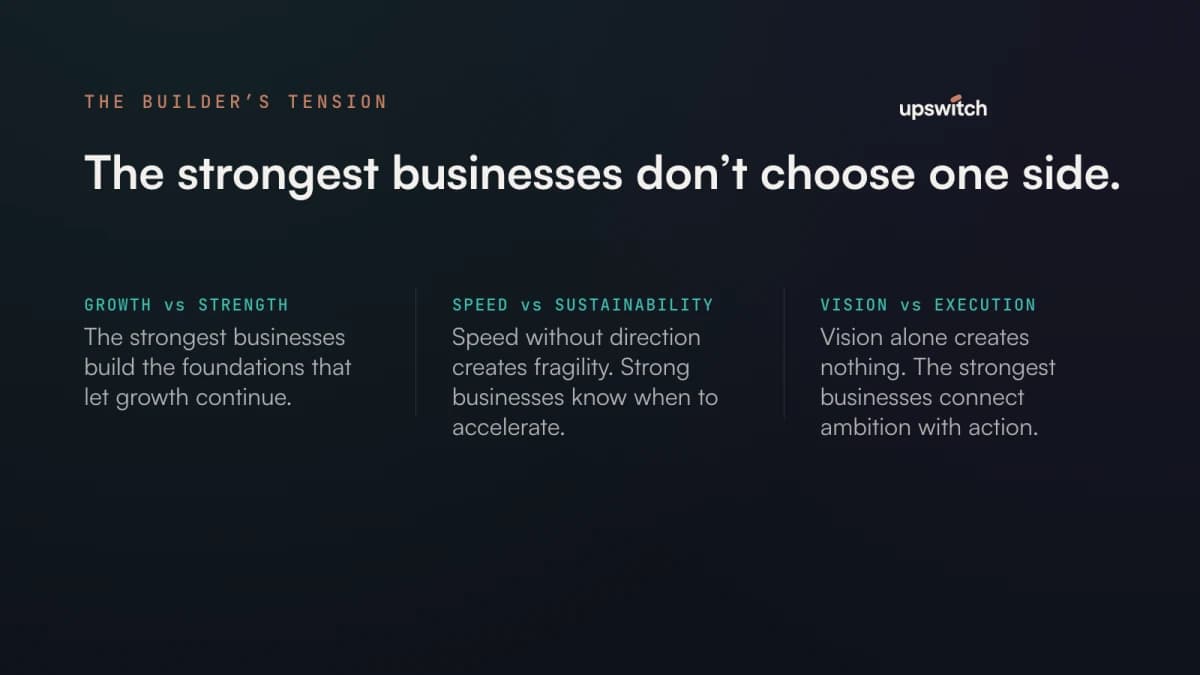
Growth wants more, now: more revenue, more clients, more headcount, more of everything that shows up on a slide. Strength wants the business to survive what more actually costs: the customer concentration, the founder dependency, the process that only lives in one person's head.
The strongest businesses do not slow down to avoid this tension. They build the foundations that let growth continue past the point where most businesses start to crack.
Speed vs sustainability
Speed wants a decision by Friday. Sustainability wants a decision that is still right in three years. Every founder has felt the pull to skip the documentation, the second opinion, the boring system, because the business needed something faster than careful.
Speed without direction creates fragility: a business that moves quickly toward whatever is easiest to break. The businesses that stay standing are not the slowest. They are the ones that know exactly when to accelerate, and when the honest answer is not yet.
Vision vs execution
Vision is the easy part to talk about. It is the version of the business that exists only in a founder's head: bigger, cleaner, inevitable. Execution is the unglamorous work of making Tuesday afternoon look a little more like that vision than Monday did.
Vision alone creates nothing. A business becomes strong at the point where ambition gets connected to action, decision by decision, in a way that someone other than the founder could actually follow.
What choosing a side costs
- Choosing growth alone produces a business that cannot survive its own success.
- Choosing strength alone produces a business that stays safe, and stays small.
- Choosing speed alone produces a business that breaks the moment nobody is watching.
- Choosing caution alone produces a business that watches slower competitors become faster ones.
The tension is not the problem
The realization moment that most founders eventually hit is not a failure. It is what happens when a business finally has enough weight to expose the gap between how big it looks and how strong it actually is. Will this business survive without me. Why does everything still come through me. Have I built a business, or just a bigger job for myself.
Those questions are not a sign something went wrong. They are a sign the business finally has enough at stake for the answer to matter.
A founder cannot resolve this tension by picking a side once and moving on. It gets resolved decision by decision, for as long as the business exists. What helps is seeing both sides on the same page at the same time, instead of guessing which one is quietly losing.
That is what a Value Curve is for: not a verdict on which side won, but a running account of both, so growth and strength can be built on purpose, together. Read Growth vs strength for a deeper look at the second half of that pair, or the 99% for why we think both should be visible to every owner, not only the largest ones.
Frequently asked questions
Is feeling this tension a sign something is wrong with the business?
No. It is usually a sign the business has grown past the point where one person could hold everything in their head, which is a normal and healthy stage, not a warning sign.
How does Upswitch help with the builder's tension?
The Value Curve tracks growth and strength on the same timeline, so a founder can see whether one is quietly outrunning the other instead of finding out from a departure, a downturn, or a buyer's due diligence.
Upswitch is the M&A infrastructure layer for the European SME economy. Defensible valuations and structured transaction matching for the lower mid-market.